
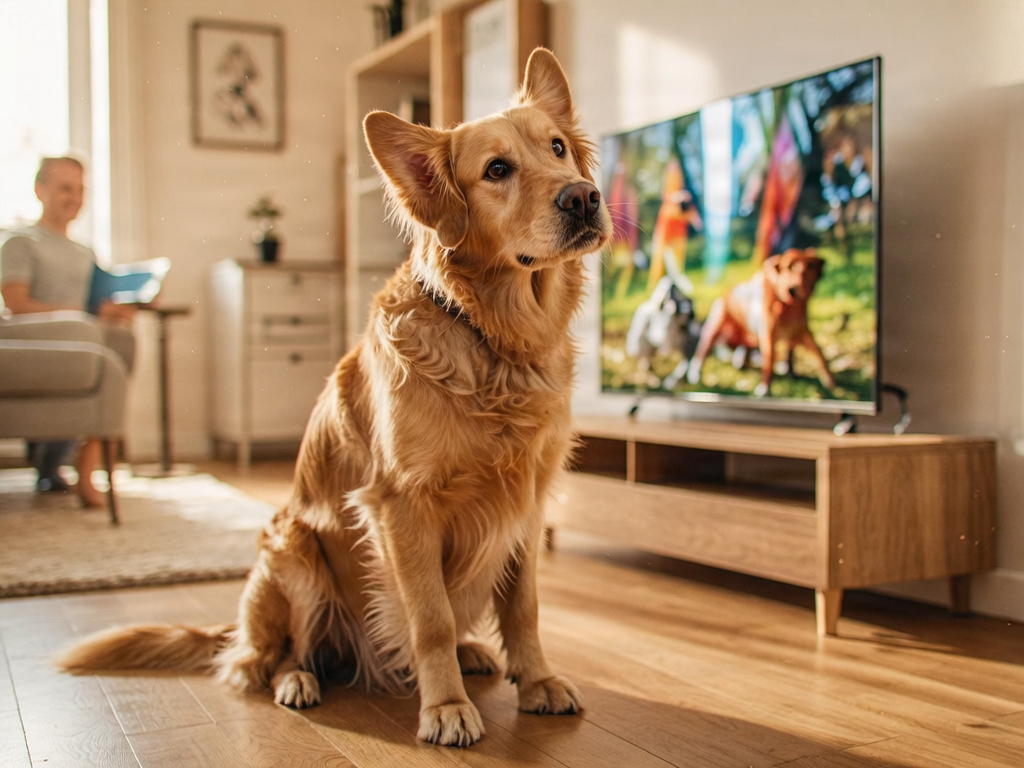

The truth about your dog, your television, and that suspiciously intense stare during the squirrel documentary.
You know the moment. You’re settled on the couch, a snack in your hand, a show on the screen. Your dog, who was napping like a furry rug two seconds ago, suddenly sits bolt upright. Head tilted. Eyes locked. Ears swiveling like tiny satellite dishes.
On the screen: a dog. Or a doorbell. Or, in a truly cursed twist, a cat.
You laugh. You grab your phone. You ask the question every dog owner has asked at least once: Is he actually watching this?
Good news: scientists have been asking the same thing, and they’ve done real research to find out. The answer is more interesting than a simple yes or no. It involves color, flicker rates, a very polite survey of 453 dog owners, and the surprising discovery that your dog may be reacting to you as much as to the screen.
Grab the remote (and maybe a treat for your co-viewer). Let’s get into it.
First, the Big Question: Can Dogs See What’s on TV?
The short answer is yes, but not the way you do.
For a long time, the answer would have been more like “sort of, but it looked terrible.” To understand why, we need to talk about how your dog’s eyes work, and it turns out they’re running a different system than yours.
The color situation
Humans are what scientists call trichromatic, meaning we have three types of color-detecting cone cells. Dogs have only two kinds of color-sensitive cones, which makes them dichromatic. In practical terms, dogs see color within two ranges of light, blue and yellow.
So no, your dog isn’t seeing the world in black and white (that’s a very old myth). But the vivid reds and greens of your favorite cooking show? To him, they’re probably more like a muted mix of yellows, blues, and grays. That gorgeous ruby-red steak on screen may look more like a shrug.
This has even shaped TV made for dogs. The canine channel DogTV prioritizes blue and yellow colors in its programming, because color matters so much to how dogs perceive media. Somewhere, a producer is color-grading a video of a golden retriever for an audience that can’t tell what shade the grass is. And honestly? Respect.
The flicker factor (the real plot twist)
Here’s where it gets fascinating, and where the technology in your living room makes a big difference.
Every screen is, technically, a series of images flashing by really fast. Your brain blends them into smooth motion. How quickly images need to flash before the brain blends them is called the flicker-fusion rate, and dogs have a faster one than we do. Dogs need roughly 70 frames per second or more, which is higher than what people need.
Why does that matter? The original cathode-ray tube televisions flickered more slowly, so dogs would have seen flashing still images rather than smooth film. Imagine trying to watch your favorite movie as a very fast slideshow. Not exactly cinema.
But modern screens changed everything. Newer sets have a faster frame rate, which is why dogs might be more interested in a high-definition television. In other words, your dog may be a bigger fan of your fancy new TV than you are. (He just can’t tell you, and he’s very busy napping on the remote.)
So Do Dogs Actually Like Watching TV?
Now we reach the juicy part. Being able to see a screen is one thing. Being interested in it is another. After all, I can see a spreadsheet, and nobody has ever described me as “enthralled.”
Researchers have tried to figure out what holds a dog’s attention, and what they’ve found is a mix of charming, surprising, and a little humbling.
Dogs prefer other dogs
Let’s start with the unsurprising news. Research that tracks dogs’ vision, using methods similar to those used with humans, has found that dogs do prefer certain images and videos, and they tend to prefer watching other dogs.
This tracks. If your entire species has spent thousands of years evolving alongside humans, you’re going to pay attention when a familiar face shows up, especially if that face has fur and a wagging tail.
There’s even a scientific test for it. A 2013 study published in Animal Cognition observed nine dogs to see whether they could pick out another dog’s face, regardless of breed, on a computer screen rather than a different animal or a person. The takeaway: dogs seem to recognize “dog” when they see it on a screen, which is a pretty remarkable thing to know about a fuzzy rectangle of light.
Sound often gets there first
Here’s a twist that might change how you think about your dog’s TV habits. Researchers have found that sound often initially attracts dogs toward televisions and other devices.
That explains a lot. The doorbell ding. The barking in a commercial. The squeaky-toy noise from a cartoon. Your dog’s head snaps toward the screen not because he’s following the plot, but because something sounded extremely important. Only then does the visual part kick in.
So when your dog suddenly leaps up and runs to the TV, he may not be reviewing the cinematography. He may simply be investigating a noise. Very responsible. Very professional. Zero understanding of the plot.
Some dogs are TV enthusiasts, and some couldn’t care less
If you’ve ever noticed that one dog in your life is glued to the screen while another snores through an entire action movie, you’re onto something real.
One study out of Auburn University set out to explore how dogs respond to television. The researchers sent surveys by Facebook and email lists, collecting responses from 453 U.S. dog owners about which TV images and sounds their dogs reacted to, and whether they barked, wagged, chased, or growled. The headline finding was that how a dog reacts to the television depends a lot on its personality.
That matches what most owners already suspect. Some dogs are natural spectators. Others are more interested in the real world and see the TV as background noise. A dog’s temperament, not just his eyesight, decides whether he becomes a couch critic or a casual bystander.
The “where did he go?” phenomenon
One of the most delightful details from that research involves a behavior you may have seen yourself. Some dogs, including one pup named Jax, will actually look behind the TV to figure out where an offscreen animal or object “went.”
Think about how adorable that is. Your dog isn’t just glancing at the screen. He sees the squirrel exit stage left, and his brain says, Hold on. It was just here. Then he trots around back to investigate. That’s not passive viewing. That’s a dog who takes continuity errors personally.
The Reality Check: Dogs Aren’t Binge-Watchers
Now for a little perspective. Before you cancel your dog walks and replace them with a premium streaming subscription for him, the research has some gentle bad news.
A 2017 study in the International Journal of Human-Computer Studies showed dogs three different screens, and they didn’t show any particular preference for one over another. The study also noted that dogs had a limited attention span for television. Another summary of early research suggested that when faced with three screens, dogs didn’t choose between them but preferred watching one screen regardless of what was on it. So the “winner” may be less about the content and more about, well, whichever screen happened to be in front of him.
And here’s the line that deserves a framed spot on a wall somewhere: research has found that even with media specifically designed for dogs, they spend the majority of their time watching nothing at all.
Yes, you read that right. Even a TV show built specifically for dogs mostly gets ignored. Imagine being a producer and learning that your target audience mostly wanders off to chew a slipper. It’s the most humbling review imaginable.
The overall picture, according to one summary, is that for the most part, dogs are far more interested in what’s going on in the real world than in what’s on TV. Which makes sense. Why watch a dog on a screen when there’s a real smell on the sidewalk, a real squirrel in the yard, and a real human holding a real snack?
Is Your Dog Watching… or Watching You?
Here’s my favorite twist in all this, and it’s the one that makes dog owners laugh and nod at the same time.
Behavior experts have pointed out that we shouldn’t assume the TV is always the star of the show. One animal behaviorist at Tufts University noted that dogs might also respond to TV because their owners do.
Read that again. Your dog may be perking up because you gasped, laughed, shouted at the screen, or leaned forward during the exciting part. To your dog, you reacting to something is a signal that Something Important Is Happening. So he looks to see what the fuss is about.
In other words, you might not be watching a movie with your dog. You might be putting on a live performance, and he’s a loyal, confused audience member who has no idea why you just yelled at a fictional detective.
This is also a good moment to appreciate how tuned in dogs are to us. They’ve spent thousands of years learning to read our faces, voices, and moods. If you gasp at the screen, your dog notices you gasping first. The TV is just the thing you were gasping at.
What Should You Actually Do With This Information?
So, is TV bad for dogs? Good for them? A harmless snack? Let’s break it down into practical, real-life takeaways.
1. A little TV can be a nice background companion. If your dog is home alone and some gentle sound makes the house feel less empty, there’s nothing wrong with leaving something on. Just think of it as ambient noise rather than enrichment.
2. Don’t count on it as a babysitter. Since dogs mostly prefer the real world, and since even dog-targeted programming gets ignored a lot, TV shouldn’t replace walks, play, or training. One behaviorist cautioned against assuming that TV is going to be enriching. The screen is not a substitute for you.
3. Pay attention to your dog’s personality. If your dog loves the screen, he might enjoy short sessions of dog-friendly content. If he ignores it, that’s perfectly normal. Neither dog is wrong.
4. Choose dog-friendly content, if you want to try it. Based on what researchers have found about dogs’ interests, content with other dogs, animals, and attention-grabbing sounds is likelier to catch their eye. Gentle, calming programming may be a nice choice when you’re away.
5. Watch for signs of stress. If the TV sends your dog into a barking frenzy, a pacing spiral, or a full-body vibration of excitement, it might be too stimulating. Turn it off, and offer a puzzle toy or a chew instead. Not every dog needs to be a film critic.
6. Remember your own role. Your dog is watching you closely. Your calm, happy reactions can make a show feel more fun for him. Your shouting at a referee can make the whole room feel like an emergency. (Sorry, sports fans.)
The Bottom Line
So, do dogs really watch TV?
Yes, sort of. They can see it, especially on modern screens with fast refresh rates. They’re drawn to certain things, like other dogs, motion, and sound. Some dogs enjoy it, while others couldn’t care less. And while they won’t follow a plot twist or cry at the season finale, they may well track a squirrel across the screen and then run around back to look for it.
But the science also gives us a gentle reality check. Dogs prefer real life. Their attention spans for screens are short. And a lot of what looks like TV-watching may actually be your dog reading your reactions.
Which, honestly, might be the sweetest finding of all. Your dog isn’t really glued to the television. He’s glued to you. The screen just happens to be what you’re staring at.
So the next time your pup tilts his head at the TV, give him a scratch behind the ears and let him enjoy the show. Whether he’s watching the squirrels, the sounds, or the person on the couch making hilarious faces at a cooking competition, he’s exactly where he wants to be.
Right next to you.